Sumber Foto: https://travelspromo.com/htm-wisata/candi-barong-sleman/
Secara administratif Candi Barong terletak di Dusun Dawangsari, Desa Sambirejo, Kecamatan Prambanan, Kabupaten Sleman, Daerah Istimewa Yogyakarta. Secara geografis, Candi Barong terletak di suatu perbukitan kapur, sawah tadah hujan dan tanah yang relatif kurang subur, dengan ketinggian 199,27 m dpl dan pada koordinat 110° 2’ 343” BT dan 7° 46’ 16” LS.
Penamaan Candi Barong oleh penduduk setempat berkaitan erat dengan adanyabhiasan kala pada masing-masing sisi tubuh candi. Hiasan semacam ini menyerupai gambaran barongan. Adapun literatur tertua yang menyebutkan candi ini adalah ROD 1915, dalam buku tersebut Candi Barong disebut dengan nama Candi Sari Sorogedug.
Candi Barong dan sekitarnya merupakan salah satu kawasan peninggalan sejarah yang menunjukkan unsur-unsur agama Buddha dan Hindu pada abad IX – X M. di sekitar Candi Barong banyak ditemukan tinggalan budaya material. Budaya material yang ada berupa candi dan bangunan lain, misalnya Candi Miri, Candi Dawangsari. Arca Ganesha, Situs Ratu Boko, dan Arca Dyani Bodhisatwa Sumberwatu.
Dikarenakan sampai saat ini belum dapat ditemukan sumber otentik berupa prasasti yang menyebut sejarah Candi Barong, maka para ahli arkeologi untuk sementara menyatakan Candi Barong didirikan antara abad IX – X M atau akhir masa klasik Jawa Tengah.
Pernyataan yang disampaikan oleh para arkeologi tentang kurun pendirian Candi Barong tersebut didasarkan atas tata letak, langgam, dan ornamen bangunan utama. Tata letak Candi Barong berteras roboh ke belakang membujur arah timur, barat, dan bangunan utamanya berada di bagian paling tinggi. Masa klasik Jawa, pada umumnya mempunyai tata letak memusat, yaitu bangunan utama berada di tengah kompleks. Langgam atau gaya profil bangunan lebih sederhana, sedangkan ornamen yang menghias bangunan tidak rumit. Ornamen yang menonjol adalah hiasan kala yang berada di ambang atas relung bangunan. Model kala ini semacam lazim digunakan dalam candi-candi di Jawa Timur, yang menurut ahli arkeologi lebih muda pertanggalannya dibanding masa klasik Jawa Tengah. Model kala masa klasik Jawa Tengah terlihat dengan gaya “garang dan menyeramkan”, sedangkan masa klasik Jawa Timur ornamen kala tampak seperti “tersenyum”. Para ahli arkeologi berpendapat bahwa pergeseran masa klasik dari Jawa Tengah ke arah timur diperkirakan terjadi pada akhir abad IX – X M.
Kondisi lingkungan di sekitar Candi Barong yang berkapur mengakibatkan tanah di sekitarnya tandus dan kering, di sisi lain masyarakatnya hidup dari mata pencaharian bertani. Kondisi tersebut mendorong masyarakat untuk menggunakan sistem tadah hujan guna memenuhi kebutuhan air dalam pertanian. Hal tersebut tentunya terkait dengan kehidupan masyarakat pendukungnya pada waktu itu. Dengan kondisi lingkungan yang tandus, sementara masyarakatnya sangat tergantung pada hasil pertanian sebagai sumber mata pencahariannya, maka mereka memilih Dewa Wisnu dan Dewi Sri sebagai dewa yang dipuja. Dalam mitologi India, Dewa Wisnu merupakan dewa pemelihara dan penyelamat dunia. Salah satu arca Wisnu yang ditemukan di candi ini duduk dalam sikap paryankasana, sikap tangannya varamudra, yaitu sikap tangan memberi anugerah, sedangkan Dewi Sri merupakan salah satu sakti Dewa Wisnu, yang dianggap sebagai Dewi Padi dalam kehidupan masyarakat Jawa, bahkan hingga saat ini. Dengan demikian, melalui pemujaan Dewa Wisnu dan Dewi Sri diharapkan mendatangkan berkah kesuburan, sehingga dapat memberikan peningkatan kesejahteraan bagi masyarakat.
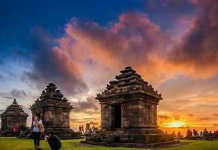
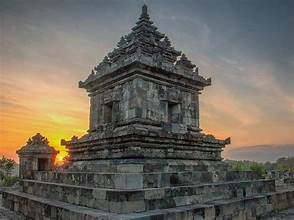
Bangunan inti yang berada di teras I terdiri atas dua buah bangunan candi yang berukuran 8,18 x 8,18 m, tinggi 9,05 m, menghadap ke barat, berjajar dari arah utara (candi I) – selatan (candi II). Kedua candi ini tidak mempunyai bilik, meskipun bangunan tengah candi berongga, hanya mempunyai relung, yang di ambang atasnya berhias kala, di keempat sisi dindingnya. Tidak seperti hiasan kala pada umumnya yang tampak garang dan menyeramkan, hiasan kala di Candi Barong tampak agak tersenyum.
Seperti bangunan candi pada umumnya, Candi Barong juga dibagi menjadi tiga bagian yaitu kaki, tubuh, dan atap candi. Pada waktu dilakukan pembongkaran dalam rangka pemugaran, di bawah candi I terdapat 9 kotak bujur sangkar dengan kotak paling besar berada ditengah. Ukuran keseluruhan 3 x 3 m, kotak tengah 1,5 x 1,5 m, kotak-kotak lainnya berukuran 1 x 1 m. Kesembilan kotak tersebut berbentuk seperti wadah peripih yang terpatakkan langsung pada tanah asli bukit tersebut.
Menurut Stella Kramrisch, kesembilan kotak ini merupakan gambaran vastupurmandala. Kotak yang berada di tengah merupakan pusat kedudukan dan tempat terpusatnya potensi gaib yang menguasai alam semesta, sedangkan 8 kotak lainnya merupakan penjelmaan dewa mata angin. Hal semacam itu tidak dijumpai pada candi II. Di sebelah kedua bangunan inti terdapat gapura masuk berbentuk paduraksa (bentuk seperti bangunan candi tetapi berlubang di tengah sebagai jalan masuk).
Bila dilihat dari segi arsitektur dan konstruksi bangunan Candi Barong, sangat jelas bahwa latar belakang keagamaannya adalah Hindu, tetapi fokus pemujaannya kepada Dewa Wisnu. Hal ini ditunjukkan dengan adanya temuan arca lepas yaitu arca Dewa Wisnu dan istrinya, Dewi Sri. Temuan arca lepas lainnya berupa arca yang belum selesai dikerjakan (unfinish), kotak peripih, mangkuk, guci keramik, mata kapak, dan sendok.
Keistimewaan Candi Barong antara lain: tata letak Candi Barong menunjukkan adanya kontinuitas dengan tradisi masa prasejarah, khususnya masa megalitikum/periode batu besar. Hal ini ditunjukkan dengan pola pembagian halaman ke belakang dengan ketinggian teras berbeda, dan kedudukan bangunan inti terletak pada batur yang tertinggi.
Konstruksi bangunannya didirikan pada sebuah bedrock (batu cadas) sebagai alasnya. Candi Barong dibangun secara bertahap, titik pusat (brahmastana) halaman menjadi satu dengan titik pusat bangunan candi.
Candi Barong mulai ditangani secara intensif sejak tahun 1979 (kegiatan prapemugaran), kemudian dilanjutkan dengan studi teknis pada tahun 1985 dan dipugar mulai tahun 1987 sampai dengan tahun 1999. Untuk selanjutnya, candi ini dimanfaatkan sebagai salah satu aset wisata untuk Daerah Istimewa Yogyakarta.
Administratively, Candi Barong is located in Dawangsari Hamlet, Sambirejo Village, Prambanan District, Sleman Regency, Special Region of Yogyakarta. Geographically, Candi Barong is situated in a limestone hilly area characterized by rain-fed rice fields and relatively infertile soil, at an elevation of 199.27 meters above sea level and at coordinates 110° 2′ 343″ E and 7° 46′ 16″ S.
The name “Candi Barong” given by the local community is closely associated with the presence of kala ornaments on each side of the temple body. These ornaments resemble representations of barongan. The oldest literature mentioning this temple is the ROD 1915, in which Candi Barong is referred to as Candi Sari Sorogedug
Candi Barong and its surrounding area constitute one of the historical heritage areas that demonstrate elements of Buddhist and Hindu religious traditions dating from the 9th–10th centuries CE. Numerous material cultural remains have been discovered around Candi Barong. These include temples and other structures, such as Candi Miri and Candi Dawangsari, a Ganesha statue, the Ratu Boko Site, and a statue of the Dhyani Bodhisattva from Sumberwatu.
Since no authentic source in the form of an inscription explicitly describing the history of Candi Barong has yet been discovered, archaeologists have provisionally concluded that Candi Barong was constructed between the 9th and 10th centuries CE, or toward the end of the Central Javanese Classical period.
The archaeologists’ dating of the construction of Candi Barong is based on the layout, architectural style, and ornamentation of the main buildings. Candi Barong has a terraced layout extending toward the rear along an east–west axis, with its main buildings situated at the highest point. During the Central Javanese Classical period, temples generally had a centralized layout, with the main building positioned at the center of the complex. The architectural style and building profiles of Candi Barong are relatively simple, while the decorative elements are not particularly elaborate. The most prominent ornament is the kala decoration located above the niches of the buildings.
This type of kala ornament is commonly found in temples in East Java, which archaeologists generally consider to have been constructed later than those of the Central Javanese Classical period. Kala ornaments from the Central Javanese Classical period typically appear “fierce and frightening,” whereas those of the East Javanese Classical period appear to be “smiling.” Archaeologists believe that the shift of the center of the Classical period from Central Java toward East Java is estimated to have occurred around the late 9th to 10th centuries CE.
The limestone environment surrounding Candi Barong has resulted in dry and infertile soil. At the same time, the local population depended on agriculture for their livelihood. These conditions encouraged the community to use a rain-fed agricultural system to meet their water requirements. This situation was closely related to the lives of the people who supported the temple at that time. Given the arid environmental conditions and the community’s strong dependence on agriculture as their primary livelihood, they worshipped Lord Vishnu and Goddess Sri as their principal deities.
In Indian mythology, Lord Vishnu is regarded as the preserver and protector of the world. One of the Vishnu statues discovered at this temple is depicted seated in the paryankasana posture, with his hand in the varamudra gesture, a hand position symbolizing the granting of blessings. Goddess Sri is regarded as one of Vishnu’s shakti or divine consorts and is associated with the Rice Goddess in Javanese society, a belief that continues to the present day. Thus, through the worship of Lord Vishnu and Goddess Sri, devotees were expected to receive blessings of fertility, thereby contributing to increased prosperity and well-being for the community.
The main structures located on Terrace I consist of two temple buildings, each measuring 8.18 × 8.18 meters and 9.05 meters in height. They face west and are arranged in a north–south alignment, with Temple I to the north and Temple II to the south. Neither temple has an inner chamber (bilik) although the central part of each temple is hollow. Instead, they contain niches whose upper thresholds are decorated with kala motifs on all four sides of the walls. Unlike the kala decorations commonly found on other temples, which tend to appear fierce and frightening, the kala ornaments at Candi Barong appear somewhat smiling.
Like temple structures in general, Candi Barong is divided into three main sections: the base, the body, and the roof. During dismantling carried out as part of the restoration process, nine square compartments were discovered beneath Temple I, with the largest compartment located at the center. The overall arrangement measures 3 × 3 meters, with the central compartment measuring 1.5 × 1.5 meters and the remaining compartments measuring 1 × 1 meter each. The nine compartments were shaped like peripih containers and were placed directly on the original bedrock of the hill.
According to Stella Kramrisch, these nine compartments represent a vastupurmandala. The central compartment represents the center of position and the concentration of supernatural forces governing the universe, while the other eight compartments represent the manifestations of the deities associated with the cardinal directions. Such an arrangement was not found beneath Temple II. Beside the two main temple structures is an entrance gate in the form of a paduraksa, resembling a temple structure with an opening in the center serving as an entrance.
From the perspective of its architecture and construction, it is clear that Candi Barong has a Hindu religious background, with its worship particularly focused on Lord Vishnu. This is demonstrated by the discovery of detached statues of Lord Vishnu and his consort, Goddess Sri. Other detached finds include an unfinished statue, peripih containers, bowls, ceramic jars, axe heads, and spoons.
One of the distinctive features of Candi Barong is its layout, which demonstrates continuity with prehistoric traditions, particularly those of the Megalithic period or the period characterized by large stone monuments. This is indicated by the arrangement of the courtyards extending toward the rear with terraces of varying heights, with the main buildings positioned on the highest platform.
The temple structures were constructed directly upon bedrock as their foundation. Candi Barong was built in stages, with the central point (brahmastana) of the courtyard coinciding with the central point of the temple structure.
Candi Barong began to receive intensive attention in 1979 through preliminary restoration activities. This was followed by technical studies in 1985, and restoration was carried out from 1987 to 1999. Subsequently, the temple has been utilized as one of the tourism assets of the Special Region of Yogyakarta.